

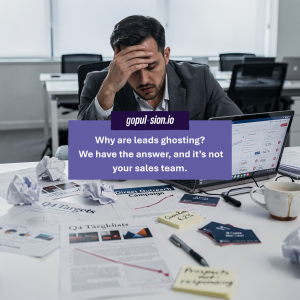
 Ghosting used to be a dating term. Today it is one of the most common challenges in B2B sales. A lead schedules a call, expresses interest, asks detailed questions and seems ready to move forward. Then silence. No reply to follow ups. No reaction to value summaries. No feedback. No explanation. Sales teams become frustrated, pipeline becomes unreliable and leadership starts to question whether performance issues are internal.
The truth is much more structural and much less personal. Buyers are not ghosting because they dislike the salesperson or the product. Buyers are ghosting because the buying environment changed. Decision making is slower, information access is broader and risk tolerance is lower. Buyers now have more tools, more content and more AI support than ever. They can research alternatives without speaking to anyone. They can analyze vendors privately. They can delay without consequence.
Ghosting is not rejection. Ghosting is a symptom of the modern buying process.
The old style of business development is no longer aligned with how buyers think
For decades, companies trained sales teams to push deals forward through persistence, follow ups, pressure and rhythm. The belief was simple. Sales wins by staying top of mind. Buyers reward consistency. Silence means a lack of effort.
Modern buyers do not think this way. They do not want to be reminded. They do not want pressure. They do not want more information than they requested. They want clarity, control and time. When follow ups feel excessive, they withdraw. When vendors push for updates too early, the buyer avoids the conversation. When salespeople send long summaries or multiple nudges, buyers interpret the behavior as misalignment with their pace.
This shift is not about sales skill. It is about buyer behavior. Buyers want to move at their own speed, supported by content, clarity and authority. They want the freedom to explore without being chased.
The real reasons buyers are ghost
Buyers are ghosting because the power in the buyer seller relationship has shifted. Three major changes drive this pattern.
The first change is information independence. Buyers no longer rely on vendors for knowledge. They conduct research through search, peer groups and AI systems. If your content does not create authority, they move on. This explains the rise of digital content creation and AI optimization, which support early stage decision making.
The second change is risk sensitivity. Buyers feel uncertain about budgets, resource allocation and technology complexity. If internal stakeholders hesitate, the deal pauses. The pause often looks like ghosting, even though internal activity continues.
The third change is the overwhelming number of vendor options. Many markets are saturated. Buyers see dozens of similar providers. If your brand does not stand out through authority building, supported by link building services, they struggle to remember you.
Ghosting often has nothing to do with the salesperson and everything to do with brand positioning.
Ghosting happens when trust is weak or incomplete
When buyers trust a brand, they respond even when the timeline shifts. When buyers feel unsure, they disappear. Trust forms long before the sales meeting. It is built through content quality, thought leadership, industry clarity and credible digital signals. These signals include:
- strong website experience
- detailed explanations
- transparent pricing and positioning
- high authority backlinks
- appearances in AI assisted recommendations
Brands that lack trust signals are easier to ignore. Buyers do not feel obligated to respond because the relationship never felt substantial. This is why CEOs invest in website conversion optimization services and modernization programs through wordpress web development, ensuring the brand looks and feels credible during early research.
Ghosting is often a trust problem, disguised as a communication problem.
AI has reshaped the way buyers validate vendors
Buyers use AI models to validate vendor claims instantly. They ask for comparisons. They ask for strengths and weaknesses. They ask for typical pricing. They ask for alternative solutions. AI models pull from digital footprints. If your brand does not appear with authority, the buyer becomes uncertain.
AI also helps buyers create internal business cases. It summarizes needs, risks and recommendations. If your content aligns with the narrative, the buyer sees you as a partner. If your content does not exist or lacks authority, you become a lower priority.
This explains why companies invest heavily in answer engine optimization, ensuring AI can interpret and reference their content accurately.
Ghosting often begins when the buyer’s AI assisted research reveals gaps in your digital authority.
Marketing, not sales, determines whether ghosting happens
A sales representative cannot overcome weak digital presence alone. The buyer makes two decisions. The first decision happens before the meeting. The second decision happens after. The first determines whether the buyer shows up. The second determines whether the buyer continues.
Both decisions are influenced by marketing, not sales.
Marketing determines:
- how clearly the brand communicates value
- whether the website supports the buyer’s logic
- whether content answers questions effectively
- whether authority signals build confidence
- whether demand generation makes the brand recognizable
Brands that invest in structured programs like digital transformation of marketing experience far less ghosting because buyers feel informed and supported.
When buyers disappear, it is usually because marketing did not prepare them well enough.
How to reduce ghosting within months
Companies often believe ghosting is unavoidable. In reality, ghosting decreases sharply when three conditions are met.
The first condition is clarity. Buyers need simple, direct messaging that helps them understand your differentiation. Clarity is more important than persuasion.
The second condition is authority. Buyers want to see real expertise demonstrated through credible resources. Thought leadership, SEO rich content and editorial quality matter.
The third condition is consistency. Buyers must experience the brand across multiple touchpoints. Consistent signals strengthen recognition and reduce hesitancy.
Brands also reduce ghosting when they rely on integrated systems such as HubSpot, supported by hubspot consultancy, which help teams understand buyer engagement patterns.
Buyers ghost when they lose confidence. They respond when confidence increases.
A closing perspective for leaders solving the ghosting problem
Ghosting is not a sales failure. It is a marketing opportunity. Buyers disappear when they feel uncertain. They disappear when they feel overloaded. They disappear when they do not clearly understand why your company is the best partner for them.
The companies that will reduce ghosting in 2026 will not send more follow ups. They will build stronger authority. They will modernize their digital experiences. They will publish the content buyers search for. They will create systems that support the buyer’s internal decision making instead of pressuring the buyer to decide quickly.
Ghosting ends when clarity begins. Clarity begins when marketing leads.