
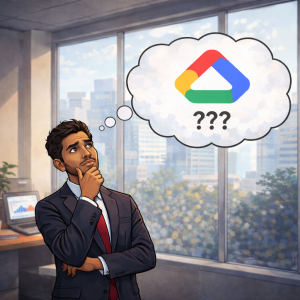
 Most common in organizations that see themselves as relationship-driven, referral-based, or enterprise-focused, some executives still can’t reconcile if or how Google ads fits into their digital marketing strategy.
It is also sometimes pondered by by firms with strong brand equity. Occasionally it is voiced by leadership teams that believe paid media signals desperation.
In 2026, that framing is outdated.
The question is no longer whether paid advertising is appropriate for your organization. The real question is whether you understand what modern paid media actually does and how it reinforces authority within AI-driven ecosystems.
Google Performance Max is not simply a demand capture tool. It is an authority amplifier operating across Google’s entire network.
Understanding who should be using it requires understanding how search, AI, and brand reinforcement now intersect.
Performance Max Is Not Traditional Search
Historically, Google Ads were simple in concept. A prospect searched for a keyword. Your ad appeared. Intent was clear. Conversion pathways were straightforward.
Performance Max is different.
It operates across Search, Display, YouTube, Discover, Gmail, and Maps simultaneously. It uses machine learning to allocate budget dynamically across channels based on predicted performance. It leverages audience signals, intent patterns, creative combinations, and behavioral modeling.
In other words, it is designed for a fragmented attention environment.
This matters because buyer journeys are no longer linear. Prospects research through search, consume video, read summaries generated by AI systems, and engage with brand touchpoints before making contact. Performance Max allows you to reinforce presence across that journey rather than relying on a single search moment.
The companies that benefit most are those with structured authority already in place.
Paid Media as Authority Reinforcement
A common misconception is that paid media creates artificial demand. In reality, well-structured paid campaigns reinforce credibility that already exists.
When your domain authority is growing, when your content ecosystem is structured and optimized through disciplined answer engine optimization, and when your messaging is cohesive, Performance Max strengthens visibility across channels.
It increases frequency. It accelerates recognition. It reinforces positioning.
Without authority, Performance Max becomes expensive amplification. With authority, it becomes efficient reinforcement.
At Pulsion, a North American digital marketing agency, we view paid media not as a substitute for organic visibility but as an integrated component of a centralized authority system.
Performance Max works best when it is part of something larger.
Who Should Be Using Performance Max?
Organizations spending more than $5,000 per month on Google search ads should strongly consider integrating Performance Max into their mix. At that level of investment, channel fragmentation becomes inefficient. Machine learning optimization across surfaces can unlock meaningful performance improvements.
Companies operating in competitive categories where brand reinforcement matters also benefit. Performance Max increases touchpoint frequency, which influences buyer perception even when direct click attribution does not capture the full journey.
Firms entering new geographic markets can leverage Performance Max to establish presence quickly while organic authority builds over time.
However, not every organization is ready.
If your website lacks structured conversion pathways, if your content ecosystem is thin, or if your CRM segmentation is unclear, Performance Max will magnify inefficiency.
Paid acceleration requires infrastructure.
Search Versus Performance Max Versus Demand Gen
Executives often ask how Performance Max compares to traditional Search campaigns or Demand Gen campaigns.
Search campaigns remain critical for high-intent queries. They capture active demand and offer precision around keyword targeting.
Demand Gen campaigns operate higher in the funnel, introducing brand narratives across YouTube and Discovery placements.
Performance Max bridges these environments. It leverages intent signals but distributes across surfaces dynamically, optimizing toward conversion objectives rather than channel-specific metrics.
In practical terms, Search captures immediate intent. Demand Gen builds awareness. Performance Max reinforces and integrates both.
The most effective strategies do not choose between them. They align them within a unified authority framework supported by structured google ads management.
AI Max Implications
Google’s ongoing integration of AI into search and advertising environments means machine learning optimization is becoming less optional and more foundational.
Performance Max aligns with this evolution. It feeds conversion data back into Google’s models, strengthening predictive targeting and creative delivery. As AI surfaces become more prominent, campaigns that are already structured within Performance Max environments will have adaptive advantages.
Organizations that delay integration may find themselves retrofitting later at greater cost.
However, AI amplification without authority discipline remains risky. Machine learning optimizes toward performance signals. If those signals originate from weak landing environments or poorly defined conversion paths, results will fluctuate.
Paid media does not fix structural weakness.
It exposes it.
The Synergy Between Paid and Organic
One of the most overlooked benefits of Performance Max is its synergy with organic authority growth.
When structured content clusters support category dominance and are reinforced internally through optimized architecture, paid traffic accelerates engagement signals. Increased dwell time, improved behavioral metrics, and stronger brand recognition contribute indirectly to organic performance.
Conversely, when organic authority strengthens, paid campaigns benefit from improved quality scores and reduced friction in conversion.
This alignment is why we built Optimize 360 as a centralized system integrating SEO, AEO, AI optimization, and paid amplification.
Paid media should not operate independently from authority architecture. It should amplify it.
Finding Clarity
For enterprise organizations or professional service firms that believe ads diminish brand equity, the concern often stems from misunderstanding.
Paid media does not replace relationships. It reinforces visibility during research phases that precede relationships.
Executives researching vendors today consult AI systems, search engines, and content ecosystems before initiating conversation. If your brand does not appear consistently across those environments, your sales team enters conversations at a disadvantage.
Performance Max ensures presence across surfaces where buyers evaluate options.
It is not about aggressive selling. It is about strategic reinforcement.
Structure Before Scale
The most important qualification for using Performance Max is structural readiness.
Do you have:
- A website engineered for conversion clarity?
- Content mapped to authority pillars?
- CRM tracking aligned with lifecycle definitions?
- Conversion events defined precisely?
If the answer is yes, Performance Max can accelerate growth meaningfully. If the answer is no, scaling budget will magnify inefficiency.
This is why we often begin with the AI and Search Engine Impact Report to benchmark authority and visibility before increasing spend. Understanding where you stand ensures that paid acceleration compounds rather than leaks.
The Real Question
The real question is not whether Google Performance Max Ads are appropriate for your organization.
The real question is whether your infrastructure is strong enough to use them efficiently.
Paid media is no longer optional in competitive markets. Visibility across AI-driven surfaces is essential. Authority must be reinforced consistently.
Performance Max, when aligned within a centralized strategy, strengthens brand presence across the buyer journey and supports measurable growth.
If you are investing in marketing but unsure whether your paid strategy is amplifying structured authority or compensating for its absence, it may be time to re-evaluate the system rather than the channel.
To learn how centralized authority, AI optimization, and paid performance can operate as one cohesive growth engine, visit www.gopulsion.io and explore how we help organizations turn visibility into measurable advantage.