

 One of the most common assumptions in digital marketing is that building meaningful visibility takes time, often measured in years rather than months. Companies are told to invest consistently, publish regularly, and wait for results to compound over time. While there is truth in the idea that authority builds progressively, this perspective often overlooks a more important factor.
Visibility does not come from time alone. It comes from structure and authority factors.
In this case, a retail merchandising company that had established considerable visibility in their segment on LinkedIn but had not yet placed focus into their footprint on Google.
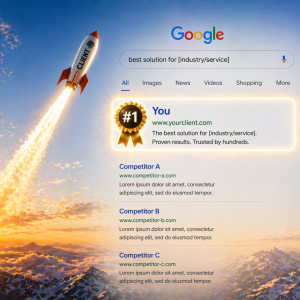
We were able to leverage existing content assets and a strong on page SEO plan to move into a top position within a matter of months. This shift was not confined to traditional search rankings. It extended into how the company appeared across AI-driven environments, where answers are generated, synthesized, and presented without the user needing to navigate through multiple sources.
The speed of that change is what makes the case worth examining.
Starting From a Position of Limited Visibility on Google
At the outset, the company was not lacking capability. It had a strong service offering, a clear understanding of its market, and a track record of delivering results for its clients.
Search presence was limited. Many blogs were appearing for specific queries but not core pages for generic search terms. More importantly, the company was largely absent from the types of structured content that are increasingly used to generate AI-driven answers.
This meant that even when potential clients were researching solutions, the company was not consistently part of that discovery process.
The opportunity was not to create demand. It was to capture demand that already existed.
Why Speed Became Possible
The reason this company was able to move quickly was not because it accelerated traditional tactics. It was because it changed the way those tactics were structured.
Instead of treating SEO, content, and visibility as separate initiatives, the approach focused on building a system where each component reinforced the others. The objective was to create a connected footprint that would be recognized and used across both search and AI-driven environments.
This required a shift in thinking.
Rather than asking how to rank individual pages, the focus moved to how the entire site could be structured to represent authority within its category.
Defining a Structured Visibility Model
The first step was to define what visibility needed to look like.
This involved identifying the core services that the company wanted to be known for, the geographic areas it operated in, and the types of questions its target audience was asking. Each of these elements was mapped into a structured framework that would guide how content was created and connected.
Service pages were aligned with clear intent. Location pages were developed to reflect regional demand. Supporting content was designed to answer specific questions in a way that could be easily interpreted and used.
This structure was not created to support a single channel. It was designed to function across multiple environments.
Building for Search and AI Simultaneously
One of the defining aspects of this approach was that it did not separate traditional search visibility from AI-driven visibility.
Content was created with the understanding that it needed to perform in both contexts.
Through answer engine optimization, content was structured to provide clear, direct answers while maintaining a cohesive narrative. This allowed it to be used not only in search results, but also in environments where answers are generated dynamically.
The impact of this became visible relatively quickly.
As content was indexed and connected, the company began to appear more consistently for relevant queries. At the same time, its presence in AI-driven outputs increased, as the structure made it easier for systems to interpret and select its content.
This dual visibility accelerated growth.
The Role of Technical Structure in Acceleration
Content alone would not have been sufficient to produce this level of change. The technical structure of the site needed to support the strategy.
Through WordPress web development, the site was reorganized to create a clear hierarchy and improve how pages were connected. Internal linking was strengthened, navigation was simplified, and the relationship between different types of content was made explicit.
This created an environment where both users and search systems could understand how the site was organized.
That clarity contributed directly to how quickly visibility improved.
From Fragmentation to Category Presence
As the system took shape, the company’s presence within its category began to change.
Instead of appearing sporadically for isolated queries, it began to show up consistently across a broader range of related searches. Its content reinforced itself, with different pages supporting the same core themes from different angles.
This is what allowed it to move into a top position.
Not by outperforming competitors on a single page, but by building a stronger overall footprint.
Within a matter of months, the company reached a position where it was consistently among the top results in its category and increasingly referenced across AI-driven outputs.
Supporting the System With Paid Visibility
To reinforce this growth, paid campaigns were introduced through Google ads management services.
These campaigns were not designed to operate independently. They were aligned with the existing content and targeted the same areas of intent. This ensured that users who encountered the company through paid channels were directed to pages that reflected the same structure and messaging as the organic content.
This consistency strengthened the overall system.
What Actually Drove the Result
The speed of the outcome was not the result of aggressive tactics or increased output.
It was the result of alignment.
Content, structure, and intent were all connected. The site reflected how the business operated. Each piece of content had a role within a larger system. Visibility was not pursued at the page level, but at the category level.
This is what allowed the company to move quickly.
Closing Perspective
The most important takeaway is not that rapid growth is always possible. It is that it becomes possible when structure is prioritized.
This company did not create more demand than its competitors.
It became more visible to the demand that already existed, across both search and AI-driven environments.
That is what drove the outcome. You can explore how this type of structured system is built here.