

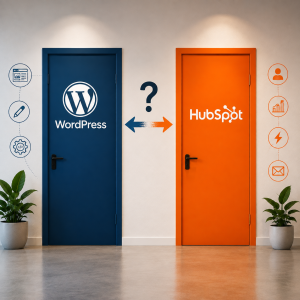
In 2027, that is not enough.
Your website has become infrastructure for a much larger digital ecosystem. Google needs to crawl and understand it, AI systems may retrieve information from it, advertising platforms send prospects into it, analytics systems measure behaviour on it and your CRM needs to know what happens when someone converts. The website also needs to support content development, authority building and whatever new digital requirements emerge as search continues moving toward AI-generated answers.
That makes the platform decision considerably more important than choosing the system with the nicest templates or the AI builder that can generate a home page before lunch.
At Pulsion, we build and work with different website technologies, and we do not believe every organization should use the same platform. A small professional services company, a growing B2B organization and an ecommerce retailer have fundamentally different requirements.
If you force us to pick a platform for a serious corporate marketing website where flexibility and long-term control matter, however, our preference remains WordPress.
That recommendation comes with an important qualification: it needs to be built properly.
WordPress remains difficult to beat for flexibility
WordPress has been around long enough that describing it as exciting may be a stretch. In this case, that is not a criticism.
Businesses should be cautious about confusing new with better when selecting infrastructure they expect to use for years.
WordPress continues to power a substantial share of the web and provides organizations with extensive control over website architecture, design, content, functionality and integrations. Its open ecosystem also means businesses are not dependent on a single vendor to determine every feature available to them.
For organizations investing seriously in search, content and AI visibility, that flexibility matters.
Professional wordpress website development can give SEO and development teams granular control over URL structures, metadata, redirects, internal linking, structured data, content templates, analytics, tracking and the technical elements surrounding how information is delivered.
It also gives organizations considerable freedom to expand functionality as requirements evolve.
That does not mean WordPress automatically produces an excellent website. An overloaded WordPress installation with a poor theme, twenty unnecessary plugins and inadequate maintenance can become slow and frustrating. The platform provides flexibility, but the quality of the implementation determines whether that flexibility becomes an advantage or a mess.
HubSpot may be the better decision for an SMB
WordPress may be our preferred platform when flexibility is the priority, but there are situations where HubSpot is the smarter business decision.
For an SMB, particularly one without a large technical team, the ability to combine the website with CRM, forms, marketing automation, sales activity and reporting can be more valuable than having maximum development flexibility.
HubSpot’s Content Hub operates within its broader customer platform, allowing website content to work alongside customer data and other marketing and sales tools.
That consolidation can eliminate a lot of unnecessary complexity.
Instead of building a WordPress website, adding forms, connecting those forms to a CRM, integrating an email platform and maintaining all the connections between them, an organization can operate much of that environment within HubSpot.
There are trade-offs. A highly customized digital experience may be easier to develop in WordPress, and businesses with complex functionality may eventually find a more open development environment preferable.
For a smaller organization that primarily needs a professional marketing website connected to its sales and marketing infrastructure, HubSpot can be extremely practical.
The right answer depends on what you actually need, not which platform wins a generic comparison.
Shopify wins when the website is really a store
Ecommerce deserves its own category because the requirements are different.
If the primary purpose of the website is selling products online, Shopify should be part of the conversation.
Shopify is built around commerce, with native functionality supporting products, inventory, checkout, payments and the broader operational requirements surrounding online retail. It also has an extensive app ecosystem for businesses that need additional functionality.
Could you build ecommerce on WordPress using WooCommerce? Absolutely, and there are situations where that flexibility is useful.
But platform decisions should not become exercises in proving what is technically possible.
If an organization needs sophisticated content, unusual functionality and commerce operating together, WordPress and WooCommerce may make sense. If the business primarily needs a dependable ecommerce engine and wants to reduce technical overhead, Shopify can be the more practical solution.
Start with the business model, then choose the technology.
What about Webflow?
Webflow has become a legitimate option for organizations that place significant emphasis on design control and want a visual development environment.
The platform combines visual website building with CMS functionality and hosting, allowing designers to create sophisticated responsive experiences without relying entirely on traditional coding workflows.
For design-led organizations, agencies, startups and certain marketing websites, that can be compelling.
Our consideration for scaling organizations is less about whether Webflow can produce an excellent website, because it clearly can, and more about what the organization will require over the lifetime of the site.
How complex will integrations become? How much content will be produced? What internal teams need to manage the site? What functionality is likely to be added? How deeply does the website need to connect with the rest of the technology stack?
If Webflow satisfies those requirements, there is nothing inherently wrong with choosing it. We simply would not select a platform based exclusively on how pleasant the design process feels during the initial build.
Launch day is the beginning of the website’s life, not the end of the project.
Wix has improved, but know what you are building
Wix is another platform that should not be dismissed based on what it was ten years ago.
The company has invested substantially in website functionality, SEO capabilities and AI-assisted site creation. Wix provides tools for editing metadata, structured data, redirects and other SEO elements, while its AI website functionality can accelerate the initial creation process.
For a small business that needs to establish a professional presence without substantial development requirements, Wix can be perfectly reasonable.
Our hesitation appears when an organization with significant growth ambitions chooses a platform primarily because it is inexpensive and easy today.
A five-page website for a small local operation and a 300-page digital authority platform for a scaling organization are not the same project. The fact that both can technically be called websites does not mean they should be built the same way.
Businesses should choose based on where they realistically expect to go.
AI website builders are going to be everywhere
By 2027, asking whether AI will be used to build websites is almost beside the point.
It will.
AI is already helping generate layouts, code, content, images and entire applications. Development teams will increasingly use AI to accelerate production, troubleshoot code and automate repetitive work.
We think that is a positive development.
Where we become cautious is when “AI can build this in an afternoon” becomes the entire website strategy.
The speed of the initial build does not tell you whether the site has strong information architecture, whether Google can consistently access important content, whether analytics and conversion tracking are configured properly or whether the platform will support several years of content and functional expansion.
AI can make building faster without making planning unnecessary.
For experimental projects, prototypes and smaller websites, rapid AI development can be incredibly useful. For a corporate website expected to become the centre of search, AI visibility, advertising and lead generation, the organization should still make the platform decision based on long-term requirements.
Search and AI visibility need to influence the platform decision
The website you build in 2027 has audiences that businesses barely considered a few years ago.
Humans remain the most important audience, but search engines and AI systems also need to access and understand the information being published.
Google’s AI search experiences continue to rely on information from across the web, while ChatGPT Search and other AI search products can retrieve current information from websites and cite sources in their responses. This makes technical accessibility and clear content architecture increasingly important.
Your services should be easy to identify. Relationships between content should make sense. Important information should not be unnecessarily hidden behind interactions that make retrieval difficult, and the platform should give your team appropriate control over technical search elements.
This is one reason we continue to favour WordPress for organizations pursuing aggressive SEO and AI optimization strategies. It provides significant control over how the website is structured and expanded.
The platform does not create authority on its own, but it should never stand in the way of building it.
Content needs room to grow
A website may launch with fifteen pages and look complete.
Two years later, the organization may have added services, locations, industries, resources, case studies, FAQs, videos and hundreds of articles.
Did the original platform and architecture anticipate that growth?
This is where website decisions made primarily around launch-day design can become expensive.
A scaling organization needs a content architecture capable of expanding without turning navigation into chaos or requiring developers to invent a new workaround every time marketing introduces another content type.
Search and AI visibility increase the importance of this issue because topical depth matters. If an organization wants to become recognized as an authority around a complex service, it needs room to develop substantive information around that subject.
The website cannot remain a beautiful ten-page brochure forever while the marketing strategy grows around it.
Your advertising infrastructure matters too
Paid acquisition creates another set of platform requirements.
Google Ads, LinkedIn campaigns and other advertising programs need landing pages, analytics, conversion tracking and reliable connections with whatever happens after someone submits a form.
Marketing teams should be able to create campaign-specific experiences without rebuilding the website every time they test a new offer.
CRM integration also matters because a conversion is not necessarily a good lead. The website needs to pass information into the systems that help the organization determine whether marketing activity is creating legitimate opportunities.
A platform that makes those routine marketing activities unnecessarily difficult creates hidden operational costs.
This is why we evaluate websites as part of the technology stack rather than treating them as standalone creative projects.
Ownership and portability deserve more attention
Businesses rarely ask about portability when everything is going well.
They start asking when they want to leave.
What happens if you change agencies? What happens if the platform changes pricing? Can your content be exported? Who owns the design and code? How difficult would migration be if your requirements changed significantly?
These are not particularly exciting questions during a website presentation, but they matter.
One of WordPress’s advantages is its open-source nature. Organizations can choose their hosting provider, development team and broader technical ecosystem rather than tying the entire website to one proprietary vendor.
That freedom can create more responsibility because somebody needs to maintain the environment properly. For larger organizations, the additional control is often worth it.
HubSpot, Shopify, Webflow and Wix offer different trade-offs between convenience and platform dependency. None is inherently wrong, but businesses should understand the relationship before making a long-term commitment.
Do not choose based on the cheapest initial price
Website budgeting creates some strange decision-making.
An organization may spend hundreds of thousands of dollars annually on salaries, advertising, sales and technology, then try to save several thousand dollars on the website through which much of that investment ultimately flows.
Your website influences first impressions, search visibility, AI discovery, conversion rates, advertising performance and the credibility of the organization. It may operate continuously for several years.
This is not the place to make a poor technology decision because one quote came in cheaper.
At Pulsion, our website programs reflect different levels of need. SMB HubSpot websites start at approximately $3,000, WordPress template-based projects start at approximately $7,000 and custom development generally starts at approximately $20,000.
Not every company needs the $20,000 option.
What every company does need is an honest assessment of which option will support the business properly.
Spending $7,000 when a $3,000 website satisfies every requirement is unnecessary. Spending $3,000 on something you will inevitably replace with a $20,000 website can be considerably more expensive.
Doing it twice rarely saves money.
So, what should you build on in 2027?
For a corporate marketing website where long-term flexibility, content, SEO and AI optimization are priorities, our first choice is generally WordPress.
For an SMB that wants to consolidate its website, CRM, forms and marketing infrastructure, HubSpot may be the smarter choice.
For ecommerce, Shopify deserves serious consideration because commerce is the platform’s core purpose.
Webflow can be an excellent fit for design-led marketing sites when its capabilities align with the organization’s longer-term requirements, while Wix can provide a practical solution for smaller businesses that need a professional presence without significant complexity.
AI website builders will continue becoming more capable, but we would evaluate them according to the same standards as every other platform. Speed is valuable, but it should not come at the expense of search, analytics, integration, ownership or scalability.
The best website platform is ultimately the one that supports what your organization is trying to accomplish without creating unnecessary limitations later.
At Pulsion, we help businesses make that decision before development begins. We look at the website in the context of search, AI optimization, advertising, CRM, content, conversion and the broader technology stack so the platform supports the strategy rather than forcing the strategy to work around the platform.
Visit gopulsion.io to learn more about our website development services, or reach out to the Pulsion team to discuss your project. We can help you determine which platform makes sense for your organization in 2027 and build a digital foundation designed to support where you are going next.