

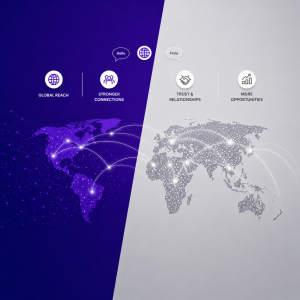
 For many companies, multilingual marketing begins as a practical requirement. As businesses expand into new regions or begin serving more diverse audiences, the need to communicate in multiple languages becomes increasingly apparent. The initial response is often to translate existing content, replicate key pages, and ensure that basic information is accessible to a broader audience.
While this approach addresses the immediate need, it does not fully capture the opportunity.
Language is not simply a medium for communication. It influences how people search, how they interpret information, and how they evaluate credibility. Treating multilingual marketing as a translation exercise limits its impact, while approaching it as a strategic advantage opens up a different level of growth.
How Language Shapes Buyer Behavior
The way people search for solutions is deeply connected to language.
Keywords, phrasing, and intent vary across regions, even when the underlying need is the same. A direct translation of a keyword does not always reflect how users in another market express their intent. This creates a gap between what companies publish and what their audience is actually looking for.
Understanding this distinction is critical.
Companies that align their content with how users search in each language are more likely to be discovered. Those that rely solely on translated content may find that their visibility remains limited, even if the information they provide is accurate.
This is where multilingual strategy becomes important.
From Translation to Market Alignment
A strategic approach to multilingual marketing goes beyond translating content.
It involves aligning messaging with the expectations, behaviors, and context of each market. This includes adapting not only language, but also how value is communicated, how problems are framed, and how solutions are presented.
For example, a company investing in Google ads management services may find that search behavior differs significantly between English and Spanish-speaking markets. The intent behind certain queries may be similar, but the way those queries are expressed can vary in ways that affect visibility and performance.
Similarly, content built through answer engine optimization needs to reflect how questions are asked in each language. This ensures that the content can be discovered and used effectively across different environments.
Building Authority Across Languages
Authority is not automatically transferred between languages.
A company that is well-established in one language may still need to build credibility in another. This requires a consistent and structured approach to content creation that reinforces key areas of expertise.
Rather than duplicating content, companies need to develop language-specific content that contributes to overall authority. This includes creating articles, service pages, and supporting materials that address the needs of each audience in a way that feels relevant and authentic.
Over time, this approach builds a stronger presence in each market.
The Role of Structure in Multilingual Visibility
Structure plays a critical role in how multilingual content performs.
A site built through WordPress web development that supports clear language segmentation, consistent navigation, and strong internal linking allows search systems to understand how different language versions are related. This improves both discoverability and usability.
Without this structure, multilingual content can become fragmented.
Pages may compete with each other, signals may be diluted, and the overall effectiveness of the strategy may be reduced.
Aligning Marketing and Sales Across Markets
Multilingual marketing also influences how leads are generated and converted.
When content aligns with how users search and evaluate solutions, the quality of inbound leads tends to improve. These leads arrive with a clearer understanding of the offering and are more likely to engage meaningfully with the sales process.
This creates an opportunity for stronger alignment between marketing and sales.
A well-structured multilingual strategy ensures that messaging is consistent across channels and that the transition from discovery to conversion is seamless.
A Competitive Advantage That Compounds
One of the most important aspects of multilingual marketing is that its benefits compound over time.
As content is developed and authority is built in each language, visibility increases. This leads to more traffic, more engagement, and more opportunities. Unlike short-term tactics, this growth is cumulative, creating a foundation that becomes more valuable as it expands.
Companies that invest in this approach early often find that they are better positioned as markets evolve.
A More Strategic Perspective
Treating multilingual marketing as a feature limits its impact. Treating it as a strategy changes how it is approached. It becomes a way to connect with audiences more effectively, to align with how they search and evaluate solutions, and to build authority in multiple markets simultaneously.
This perspective shifts the focus from translation to growth.
The difference between translation and strategy becomes visible in performance.
Companies that rely on translation alone may have a presence in multiple languages, but that presence is often limited in reach and impact. Companies that approach multilingual marketing strategically tend to see stronger visibility, better engagement, and more consistent growth across markets.
This is not a marginal improvement.
It is a structural advantage.
Multilingual marketing is not about speaking more languages. It is about understanding how language influences behavior and structuring your approach accordingly. Companies that recognize this are not simply expanding their reach. They are strengthening their position.
You can explore how this type of structured system is built here.